PPE Certificate Set Before Shipment: What to Request First
Key Takeaways
- Request the test report, DoC, batch traceability sheet, third-party inspection record and material certificate at quotation stage, not after order placement.
- Verify the level (A4, S3, FFP3) and the batch number on the certificate against your PO — the standard number alone is not enough.
- Run a 30-minute on-site inspection before the container is sealed; it catches mismatches no document review will find.
- PPE and industrial accessories can share one PO and one container, but each category needs its own certificate set.
- A missing or mismatched certificate adds roughly two weeks of delay and one extra freight leg at destination.
Why the Certificate Set Decides Your Clearance
Customs in the UAE, Saudi Arabia, Australia and Vietnam all ask for a test report or declaration of conformity that matches the batch you actually received. When that document is missing, or when it covers a different batch number, clearance stalls and the end client refuses acceptance. Replacing the certificate after the container has landed typically adds two weeks and one extra freight leg. The certificate set is not paperwork for compliance officers — it is the single item that decides whether your PPE order clears the port on the first attempt.
The Five Documents to Request Upfront
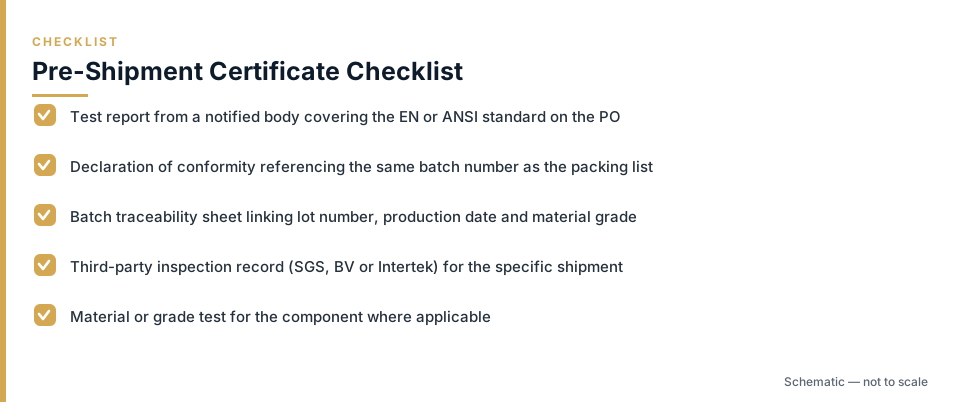
Ask for these five items in writing at the quotation stage, not after the order is placed. Each one covers a different risk and they are not interchangeable.

- Test report from a notified body covering the EN or ANSI standard cited on your PO.
- Declaration of conformity (DoC) referencing the same batch number as the packing list.
- Batch traceability sheet linking lot number, production date and material grade.
- Inspection record from a third-party agency (SGS, BV, Intertek) for the specific shipment.
- Material certificate or grade test for the component (steel, alloy, membrane, foam) where applicable.
How to Match the Certificate to Your PO
A certificate is only valid if every field on it lines up with the specification you ordered. Check these fields line by line before you accept the shipment.
| PO field | Certificate field to verify | Common mismatch |
|---|---|---|
| Standard and grade (e.g. EN 388:2016 A4) | Standard number and level on test report | Report cites EN 388:2003 instead of 2016 |
| Grade stated as A3 instead of A4 | Product model / SKU | Model number on DoC |
| DoC lists a generic family code | Batch / lot number | Batch reference on test report |
| Report covers a different production run | Material and colour | Material column on test report |
| Material not listed at all | Quantity and size range | Scope of test report |
| Report covers only part of the size range |
Grade Verification: What the Number Actually Means
Buyers often accept a certificate because it carries a standard number, without checking whether the level matches the site hazard. The level is what the test report proves; the standard number alone proves nothing.
| Category | Standard | Level to verify on report | What the level proves |
|---|---|---|---|
| Cut resistant gloves | EN 388:2016 | A4 / A5 / A6 | Cut resistance index (ISO 13997 method) |
| Safety helmet | EN 397 / ANSI Z89.1 | Type, Class, penetration energy | Impact and penetration performance |
| Safety harness | EN 361 | Load rating, anchor type | Static strength under fall load |
| Safety footwear | EN ISO 20345 | S1P / S3 / S3 SRC | Puncture, energy absorption, slip |
| Respirator | EN 149 | FFP2 / FFP3 | Filter efficiency and fit factor |
| Welding helmet | EN 379 | DIN 16103 shade range | Optical filter class and UV/IR protection |
The standard number on a certificate is a label; the level and the batch number are the proof.
What to Check at the Inspection Site
Before the container is sealed, walk the inspection checklist. A 30-minute on-site check catches the mismatches that no document review will find.
- Confirm the batch number printed on the product matches the packing list and the test report.
- Check the size distribution against your PO — a 10% tolerance is normal, more is not.
- Inspect the CE or EN marking on the product itself; it must be legible and permanent.
- Verify the colour and material grade against the sample approved at quotation.
- Photograph the inspection and attach the images to the shipment file for the end client.
How to Combine PPE and Industrial Accessories on One PO
PPE and industrial accessories clear the port under different document sets, but they can travel on the same PO and the same container. Group them by destination port and by end client, not by product category. One consolidated inspection, one set of shipping documents, one clearance file. The certificate set for the PPE line does not cover the accessories — request those separately, but ship them together.