PPE Inspection Checklist: What to Verify on Arrival

Key Takeaways
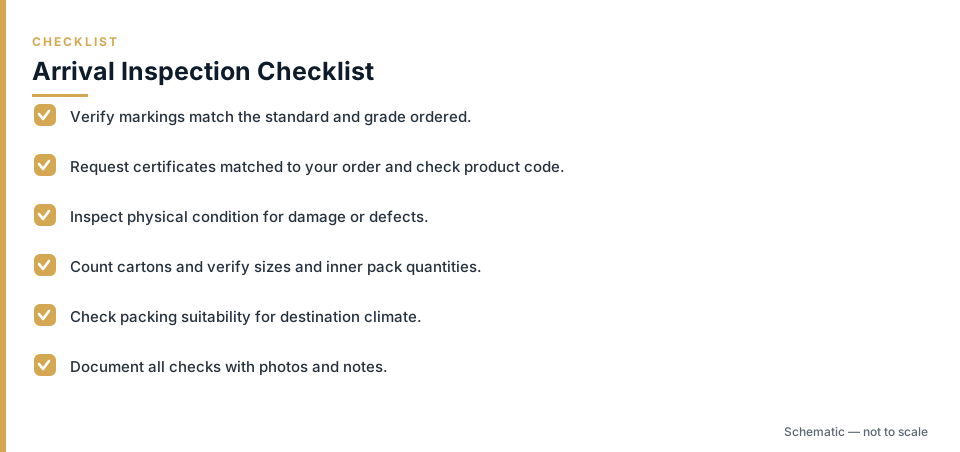
- Verify markings against the standard you specified — not just the brand name.
- Request certificates matched to your order and confirm they cover the exact product code.
- Inspect physical condition of every category, especially helmets, harnesses, and respirators.
- Count beyond cartons — verify sizes and inner pack quantities.
- Document all checks with photos and notes for warranty claims.
Every PPE order you receive has already been paid for. The question is whether what arrived is what you specified — and whether it will perform when a worker's safety depends on it. Counting cartons is not inspection. A 20-minute check at the dock or warehouse saves you from costly returns, rejected shipments, and the far worse cost of a failure on site.
Verify Markings and Labels
Each PPE item must carry the required markings. These are not decorative — they are the traceable evidence of the standard it was built to. Check that the marking matches the grade you ordered and the certificate you requested.
- Cut-resistant gloves: EN 388:2016 marking with abrasion, cut, tear, and puncture levels (e.g., 4X43C).
Safety helmets: EN 397 or ANSI Z89.1 marking, including shell and suspension type.
Safety footwear: EN ISO 20345 marking with class (S1P, S3) and additional requirements (SRC, E, CI).
Hi-vis clothing: EN ISO 20471 marking with class (1, 2, or 3) and fabric area.
Respirators: EN 149 marking with FFP level (FFP1, FFP2, FFP3) and filter class.

| Category | Standard | Marking to Check |
|---|---|---|
| Cut-resistant gloves | EN 388:2016 | Abrasion, cut, tear, puncture levels Safety helmets |
| EN 397 | Shell type, suspension, size Safety footwear |
EN ISO 20345 |
| Class (S1P, S3), SRC, toe cap Hi-vis clothing |
EN ISO 20471 | Class 1/2/3, fabric area Respirators |
| EN 149 | FFP level, filter class |
Check Certificates Against Your Order
Certificates must match the specific order — not a generic brochure. For each carton or batch, request the certificate that corresponds to the product code, size, and grade you purchased. Verify that the certificate number, standard, and performance levels align with the markings on the product.
- Ask for certificates matched to your order — not a sample or a generic file.
Confirm the certificate covers the exact standard you specified (EN 388, EN 397, EN ISO 20345, etc.).
Check that the certificate date is current and the issuing body is recognized.
If certificates are not yet available, arrange them before shipment — confirmed per order.
A certificate that does not match the product code is as useful as no certificate at all.
Inspect Physical Condition
Damage during transit or storage can compromise protection. Look for visible defects, deformation, or contamination. For safety-critical items like harnesses and helmets, even minor damage can be a reason to reject.
- Helmets: check for cracks, deformation, or UV damage on the shell.
Harnesses: inspect webbing for cuts, fraying, or chemical stains; check buckles and D-rings.
Gloves: verify no holes, tears, or delamination of coating.
Footwear: check sole adhesion, toe cap integrity, and waterproofing (if specified).
Respirators: ensure filters are sealed and within shelf life.
Verify Quantity and Packing
Count beyond the carton level. Spot-check inner packs and sizes. Incorrect counts are common, but mislabeled sizes can be worse — a worker wearing the wrong size glove or harness is at risk.
- Count cartons, then sample-count inner packs per carton.
Verify size distribution matches your PO (e.g., glove sizes 8-11, helmet sizes 52-62).
Check that packing is suitable for the destination climate — moisture barrier for sea freight, UV protection for outdoor storage.
Confirm that labels on cartons match the contents and the packing list.
Document Everything
Keep a record of what you checked and what you found. Photograph any discrepancies. This documentation is your evidence if you need to claim under warranty or return goods.
- Use a digital checklist with photos for each batch.
Record the certificate number and the product code for each line item.
Note any deviations — even minor ones — and communicate them to the supplier immediately.
Retain inspection records for at least the shelf life of the product.
| Check | What to Look For | Action if Failed |
|---|---|---|
| Markings | Correct standard and grade | Reject or request replacement Certificates |
| Match product code and standard | Request corrected document Physical condition |
No damage or defects |
| Set aside for return Quantity |
Count matches packing list | Claim shortage Packing |
| Suitable for climate | Request repacking |
Key Takeaways
- Always verify markings against the standard you specified — not just the brand name.
Request certificates matched to your order and confirm they cover the exact product code.
Inspect physical condition of every category, especially helmets, harnesses, and respirators.
Count beyond cartons — verify sizes and inner pack quantities.
Document all checks with photos and notes for warranty claims.