Safety Helmet MOQ and Lead Time: What to Specify Before You Order
Key Takeaways
- Standard helmets have lower MOQs (500 pieces) and shorter lead times (15-20 days).
- Custom colors and printing raise MOQ to 1,000+ pieces and add 5-10 days.
- Always specify the full standard (EN 397 or ANSI/ISEA Z89.1) in your PO.
- Confirm lead time in writing and add a 5-7 day buffer for transport.
- Request certificates matched to your order, not a generic claim.
- Consolidate helmets with other PPE to fill a container and cut freight costs.
Ordering safety helmets without a clear MOQ and lead time agreement is a common cause of delayed site openings and emergency airfreight costs. This guide explains the main factors that determine minimum order quantities and production timelines, and gives you a checklist of specifications to confirm before you commit. By the end, you will know what to write into your PO and when to expect your shipment.
What Drives the MOQ
Safety helmet MOQs are not arbitrary. They are set by the production economics of injection molding and by the cost of color changes and shell variants. Understanding these drivers helps you negotiate realistic quantities and avoid paying for unused capacity.
- Shell color: a standard color (white, yellow, orange) usually has a lower MOQ, often around 500 pieces. A custom color or a two-tone shell raises the MOQ to 1,000-2,000 pieces.
Suspension type: standard ratchet suspension is the default. A pin-lock suspension or a specific headband size range may require a separate production run.
Ventilation and accessory slots: helmets with ventilation holes or slots for earmuffs and visors are standard in some factories, but a unique configuration can increase the MOQ.
Printing and logos: a simple one-color logo print adds little to the MOQ. Multi-color or large-area printing may push the MOQ higher.
Packaging: individual polybag packing is standard. A custom retail box or a specific carton quantity can affect the MOQ.
| Option | Typical MOQ (pieces) |
|---|---|
| Standard color, no print | 500 Custom color |
| 1,000 Custom logo, one color |
500 Custom logo, multi-color |
| 1,000 Custom packaging |
1,000 |
Lead Time Factors
Lead time is the time from order confirmation to shipment readiness. It includes raw material procurement, injection molding, assembly, printing, quality inspection, and packing. A standard order of a popular model with no custom features might take 15-20 days. Custom colors, printing, and testing add days.
- Raw material: ABS or HDPE pellets are usually in stock. A special UV-stabilized or flame-retardant grade may need to be ordered, adding 5-7 days.
Molding: injection molding is fast, but the mold capacity and the number of cavities determine output per day. A typical mold produces 500-1,000 shells per day.
Assembly and printing: adding the suspension, chin strap, and printing the logo takes 3-5 days for a standard order.
Quality inspection: a full inspection of a 1,000-piece order takes 1-2 days. A third-party inspection may add 3-5 days.
Testing: if you require a batch test certificate (e.g., for EN 397), the sample must be sent to a lab. This adds 7-14 days to the lead time.
| Order Type | Lead Time (days) |
|---|---|
| Standard, no print | 15-20 With logo print |
| 18-25 Custom color |
20-30 With batch test |
| 25-35 |
The safest way to protect your schedule is to confirm the lead time in writing and to add a buffer of 5-7 days for customs and inland transport.
What to Specify in Your PO
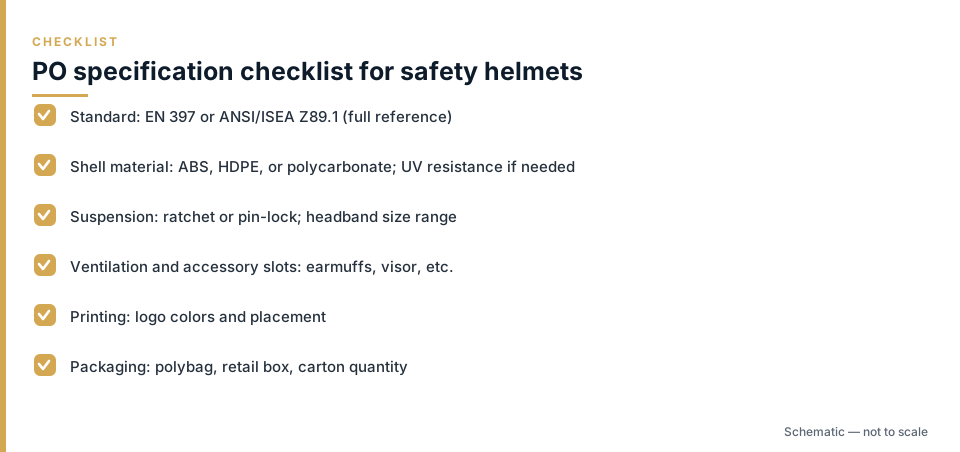
A complete PO prevents misunderstandings and ensures you receive the exact product you expect. Below is a checklist of the critical specifications to include for safety helmets.
- Standard: EN 397 or ANSI/ISEA Z89.1. Write the full standard reference, not just 'EN' or 'ANSI'.
Shell material: ABS, HDPE, or polycarbonate. Specify if you need UV resistance or a specific color code.
Suspension: ratchet or pin-lock, and the head size range (e.g., 52-62 cm).
Ventilation: with or without vents.
Accessory slots: for earmuffs, visors, or a chin strap. Specify if you need a 4-point or 6-point harness.
Weight: typical weight is 350-450 grams. If a specific weight is critical, state it.
Printing: logo placement, size, and number of colors. Provide artwork in a vector format.
Packaging: individual polybag, inner box, or export carton. Specify the carton quantity and labeling.
Documents: certificates matched to your order (EN 397 test report, ISO 9001 QMS certificate on request), packing list, and commercial invoice.
Inspection and Quality Checks
A pre-shipment inspection is your last chance to catch defects before the container leaves the factory. Focus on the points most likely to fail.
- Shell integrity: check for cracks, warping, or rough edges. The shell should be uniform in color and free of flash.
Suspension fit: the suspension should snap in securely and not rattle. The ratchet should adjust smoothly.
Printing quality: the logo should be legible, correctly positioned, and not easily rubbed off.
Packaging: verify the carton quantity, labeling, and that the helmets are packed to avoid damage in transit.
Random sampling: for a 1,000-piece order, inspect at least 20 pieces (2%). For a larger order, use a standard AQL of 2.5 for major defects.
| Check Point | Acceptance Criteria |
|---|---|
| Shell cracks | None Suspension defects |
| Less than 2% Printing defects |
Less than 2% Packing errors |
| None |
Consolidate with Other PPE
Safety helmets rarely ship alone. You can combine them with other PPE categories to fill a container and reduce per-unit freight costs. This is a standard practice for an integrated supply partner.
- Combine with cut-resistant gloves, safety footwear, and hi-vis vests in one order.
Use the same lead time window to plan a single shipment.
Request a combined packing list and a single set of documents for the whole order.
Key Takeaways
Before you finalize your order, keep these points in mind.
- Standard helmets with no custom features have the lowest MOQ and shortest lead time.
Custom colors and printing increase both MOQ and lead time.
Always specify the full standard (EN 397 or ANSI/ISEA Z89.1) in your PO.
Confirm the lead time in writing and add a buffer for transport.
Request certificates matched to your order, not a generic claim.
Plan to consolidate helmets with other PPE to save on freight.
FAQ
Answers to common questions about safety helmet ordering.
Q: What is the difference between EN 397 and ANSI/ISEA Z89.1? A: EN 397 is the European standard for industrial safety helmets, covering impact, penetration, and flame resistance. ANSI/ISEA Z89.1 is the North American standard, with Type I (top impact) and Type II (top and lateral impact) classifications. Choose based on your target market.
Q: Can I get a sample before placing a bulk order? A: Yes, samples are typically available. The sample cost is often deducted from the bulk order. Confirm the sample lead time (usually 3-5 days) and the shipping method.
Q: What documents should I request with my order? A: Request a packing list, commercial invoice, and certificates matched to your order. For EN 397, ask for the test report from an accredited lab. An ISO 9001 QMS certificate can be provided on request.
Q: How many helmets fit in a 20-foot container? A: A 20-foot container can hold roughly 10,000-15,000 helmets, depending on the model and packaging. A 40-foot container holds about double that. Confirm the exact carton dimensions with your supplier.
Q: What is the typical shelf life of a safety helmet? A: Most manufacturers recommend replacing helmets every 3-5 years from the date of manufacture, not the date of purchase. The shell material degrades over time, especially with UV exposure. Check the manufacturing date stamped on the shell.
Frequently Asked Questions
What is the difference between EN 397 and ANSI/ISEA Z89.1?
EN 397 is the European standard for industrial safety helmets, covering impact, penetration, and flame resistance. ANSI/ISEA Z89.1 is the North American standard, with Type I (top impact) and Type II (top and lateral impact) classifications. Choose based on your target market.
Can I get a sample before placing a bulk order?
Yes, samples are typically available. The sample cost is often deducted from the bulk order. Confirm the sample lead time (usually 3-5 days) and the shipping method.
What documents should I request with my order?
Request a packing list, commercial invoice, and certificates matched to your order. For EN 397, ask for the test report from an accredited lab. An ISO 9001 QMS certificate can be provided on request.
How many helmets fit in a 20-foot container?
A 20-foot container can hold roughly 10,000-15,000 helmets, depending on the model and packaging. A 40-foot container holds about double that. Confirm the exact carton dimensions with your supplier.
What is the typical shelf life of a safety helmet?
Most manufacturers recommend replacing helmets every 3-5 years from the date of manufacture, not the date of purchase. The shell material degrades over time, especially with UV exposure. Check the manufacturing date stamped on the shell.