Safety Helmet Expiry Date: What to Check Before Ordering

Key Takeaways
- Always specify a maximum production age of 6 months in your purchase order for safety helmets.
- Check the moulded production date on the shell, not a printed sticker, at goods receipt.
- EN 397 helmets are typically rated for 3 to 5 years from manufacture; suspension should be replaced every 12 months.
- Request a test report and a certificate matched to your order, not a generic document.
- Consolidate helmets with gloves, footwear and hi-vis clothing on one order to save freight cost.
Why the Production Date Decides Your Order
A safety helmet shell is made of UV-stabilised HDPE or ABS. Both age under sunlight, heat and chemical exposure, even when the helmet sits unused in a warehouse. The expiry date is calculated from the date of manufacture, not from the date you receive the goods. If your supplier ships helmets that were produced 24 months ago, you have already lost a third of the usable life before the box is opened. This is why the production date must be written into your purchase order as a mandatory field.
For EN 397 and ANSI-ISEA Z89.1 helmets, the standard practice is a service life of 3 to 5 years from manufacture, depending on the material and the working environment. Polycarbonate shells are typically rated for 3 years, HDPE for 5 years. The shell and the suspension (headband, cradle straps) age at different rates. The suspension should be replaced every 12 months in continuous use, even if the shell looks new. A buyer who ignores these dates will receive stock that fails a site audit or must be scrapped immediately.
| Shell material | Typical service life | Replacement note |
|---|---|---|
| HDPE | 5 years | Check for cracks, fading, chalky surface ABS |
| 3 to 5 years | More sensitive to UV and chemicals Polycarbonate |
3 years |
| Replace shell if any impact occurred Suspension / headband |
12 months | Replace even if shell is within life |
The expiry date is calculated from the date of manufacture, not from the date you receive the goods.
How to Read the Production Date Marking

Every EN 397 or ANSI Z89.1 helmet must carry a permanent marking with the date of manufacture. The marking is moulded into the shell, not printed on a sticker. A sticker can be removed or replaced, which is why auditors look for the moulded date. The date format is usually a four-digit year followed by a two-digit month, for example 2024-03. Some manufacturers use a week code, for example 2412 meaning the 12th week of 2024. If you cannot find the date, reject the batch.
The marking must also include the standard number (EN 397 or ANSI Z89.1), the manufacturer's name or trademark, and the head size range. A helmet without these markings is not a certified industrial helmet, regardless of what the packing list says. When you receive a shipment, check a sample of at least 5 helmets from different cartons. The production date should be within the last 6 months for a fresh order. If the date is older than 12 months, negotiate a discount or reject the lot.
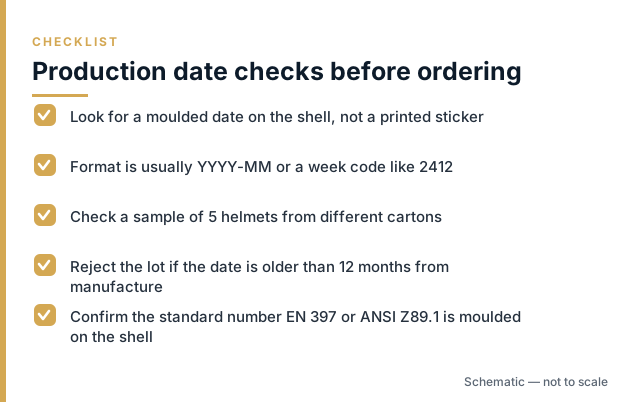
- Look for a moulded date on the shell, not a printed sticker
Format is usually YYYY-MM or a week code like 2412
Check a sample of 5 helmets from different cartons
Reject the lot if the date is older than 12 months from manufacture
Confirm the standard number EN 397 or ANSI Z89.1 is moulded on the shell
What to Write in Your Purchase Order
The production date requirement must be explicit in the purchase order, not left as an assumption. Add a line that states: 'Helmets must be manufactured within the last 6 months from the date of shipment. Moulded production date required on each shell. Certificates matched to your order.' This gives you a contractual basis to reject stock that is already close to expiry.
Also specify the standard and the grade. For EN 397, add the optional requirements you need: electrical insulation (440 V a.c.), lateral rigidity, low temperature performance (-30 °C or -20 °C), or molten metal resistance. For ANSI Z89.1, specify Type I (top impact) or Type II (top and lateral impact), and Class E (electrical), G (general) or C (conductive). A helmet that meets the standard but not the optional class will fail a site audit.
| Field | What to specify | Why it matters |
|---|---|---|
| Standard | EN 397 or ANSI Z89.1 | Defines the test basis Optional class |
| Electrical, lateral, low temp | Matches site risk Production date |
Within 6 months of shipment |
| Preserves service life Marking |
Moulded date on shell | Prevents sticker fraud Documents |
| Test report, certificate on request | Verifies conformity |
Inspection Checklist at Goods Receipt
When the container arrives, do the inspection before you accept the goods. Open 3 to 5 cartons from different positions in the container. Check the moulded date on each shell. Confirm the standard number and the head size range are present. Look for cracks, deep scratches, or a chalky surface on the shell. Press the shell with your thumb; it should flex slightly and return without permanent deformation. If the shell is brittle or shows white stress marks, reject the batch.
Check the suspension system. The headband should adjust smoothly, the cradle straps should be firmly attached, and the chin strap buckle should click into place. A helmet with a damaged suspension is not usable even if the shell is perfect. Also check the packing: helmets should be packed in individual cartons or with soft separators so they do not rub against each other in transit. Scratched shells from poor packing are a common reason for rejection.
- Open 3 to 5 cartons from different container positions
Verify moulded production date and standard number on each shell
Press the shell to check for flexibility and return
Test headband adjustment and chin strap buckle
Check for transit scratches from poor packing
Documents to Request with Your Order
For a compliant order, request the following documents along with the helmets: a test report for the specific standard (EN 397 or ANSI Z89.1), a certificate of conformity matched to your order, and a packing list that shows the production date per carton. The test report should show the batch number and the test date. The certificate should list the standard, the model, and the production period. If the supplier cannot provide these, treat it as a red flag.
Remember that certificates are matched to your order and confirmed per order. You do not need to accept a generic certificate that covers a different model or a different production batch. Ask the supplier to confirm that the certificate corresponds to the exact helmets in your container. This is a standard request for an integrated supply partner and should be answered within 24 hours.
| Document | What to check | Acceptance |
|---|---|---|
| Test report | Standard, batch, test date | Matches your order Certificate |
| Model, standard, period | Matched to your order Packing list |
Production date per carton |
| Within 6 months Inspection report |
Sample size, results | 5 helmets minimum |
Matching Helmets with Your Other PPE Orders
Safety helmets are rarely ordered alone. On the same purchase order you will typically include cut-resistant gloves, safety footwear, and hi-vis clothing. Consolidating these items into one shipment saves freight cost and simplifies customs clearance. When you combine orders, apply the same production date rule to all PPE items. Gloves, footwear and clothing also have shelf-life limits, although they are less critical than helmets.
For a site that works at height, pair the helmet with a full-body harness to EN 361 and a shock-absorbing lanyard to EN 355. For a welding workshop, add an auto-darkening welding helmet to EN 379 and welding gloves to EN 12477. For a chemical plant, add chemical-resistant gloves to EN 374 and protective clothing to EN ISO 11612. The helmet is the anchor item; the rest of the PPE is matched to the same risk assessment.
The helmet is the anchor item; the rest of the PPE is matched to the same risk assessment.