Fall Protection Kit for Tower Work: Harness, Lanyard and Anchors

Key Takeaways
- A tower work fall protection kit must be a matched system: harness, lanyard, and anchor connector, each built to its EN standard.
- The lanyard length and anchor position determine the fall distance; keep free fall under 6 meters for EN 355 lanyards.
- Verify the certificate for each component: standard number, product model, and test results must match your order.
- Inspect the kit on arrival: check webbing, buckles, connectors, and that the energy absorber is not deployed.
- Request certificates matched to your order and confirmed per order before shipment.
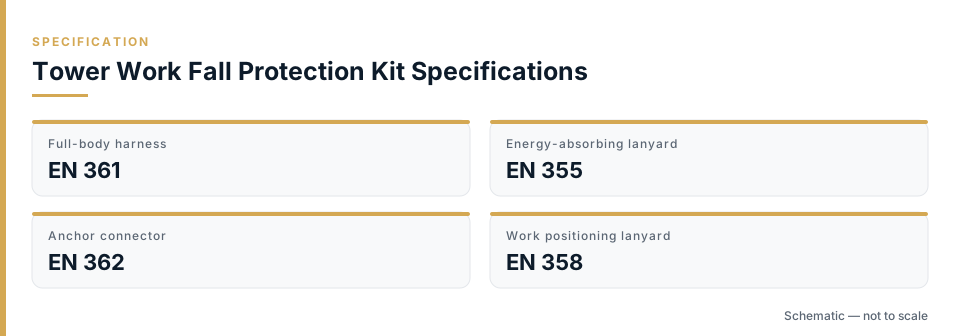
When you buy a fall protection kit for tower work, the risk is not the individual components — it is the mismatch between them. A harness built to EN 361, a lanyard to EN 355, and an anchor connector to EN 362 must work as one system. If the lanyard is too short for the anchor position, or the harness size is wrong for the worker, the kit cannot be used on site. This article gives you a practical kit list and a certificate-checking routine so you can order with confidence.
What a Tower Work Kit Must Include
A complete tower work kit is more than a harness and a lanyard. It includes the anchor point connector, the energy absorber, and the connection elements. Each part has its own EN standard. When you specify the kit, list every component and its standard.
- Full-body harness (EN 361) with dorsal and sternal attachment points
Energy-absorbing lanyard (EN 355) with connectors (EN 362)
Anchor point connector (EN 362) — carabiner or scaffold hook
Adjustable lanyard for work positioning (EN 358) if needed
Storage bag and inspection tag for each component

| Component | EN Standard | Key Check |
|---|---|---|
| Full-body harness | EN 361 | Dorsal point, size range Energy-absorbing lanyard |
| EN 355 | Max arrest force 6 kN Anchor connector |
EN 362 |
| Gate strength, corrosion Work positioning lanyard |
EN 358 | Adjustable, length |
How to Match Lanyard and Anchor Points
The lanyard length and the anchor position determine the fall distance. A standard 2-meter lanyard with an energy absorber requires a minimum clearance below the anchor point. For tower work, the anchor is often at the worker's feet or above. Measure the free fall distance and ensure it does not exceed 6 meters for EN 355 lanyards. If the anchor is at foot level, a shorter lanyard or a fall arrester (EN 360) is safer.
- Check the lanyard's maximum arrest force (typically 6 kN) on the label
Verify the connector gate strength (EN 362 requires 15 kN for self-closing gates)
Ensure the anchor point is rated for at least 12 kN for one person
Select a lanyard length that keeps the free fall below 6 meters
Certificate Verification Checklist
Before you place an order, request the certificate for each component. The certificate must show the EN standard, the product model, and the test results. Do not rely on a generic statement. Use this checklist to verify.
| Certificate Field | What to Verify | Acceptable |
|---|---|---|
| Standard | EN 361, EN 355, or EN 360 | Exact standard number Product model |
| Matches the product you order | Same model name/number Test results |
Max arrest force, dynamic performance |
| Values within limits Issuing body |
Notified body or accredited lab | Name and number |
A certificate that does not match the product model is as useful as no certificate at all.
Inspection and Packing for Your Order
When the goods arrive, inspect each kit before acceptance. Check the harness for stitching, the lanyard for damage, and the connectors for gate function. Verify that the labels and certificates correspond to the actual products. Packing should protect the components from dust and moisture. Typically, each harness is packed in a polybag with a label, and lanyards are coiled to avoid kinks.
- Inspect webbing for cuts, fraying, or chemical damage
Check all buckles and adjusters for smooth operation
Confirm the lanyard's energy absorber is not deployed
Verify the certificate model matches the product label
Documents You Can Request
For each order, you can request the following documents: the EN certificate for each component, a declaration of conformity, and test reports if available. These are matched to your order and confirmed per order. Ask for them before shipment to avoid delays.
- EN 361 certificate for the harness
EN 355 certificate for the lanyard
EN 362 certificate for connectors
Declaration of conformity
Test reports (if available)