Cut Resistant Gloves A4 vs A5 vs A6: Which Level Your Site Actually Needs
Key Takeaways
- Match the cut level to the actual hazard, not to the highest level available; A4 for packaging, A5 for glass and auto parts, A6 for steel fabrication.
- EN 388:2016 and ANSI-ISEA 105-2016 use different test methods and do not map 1:1; specify the standard explicitly on the PO.
- Higher cut level means lower dexterity and higher unit cost; over-specifying makes workers take the gloves off.
- Always request the EN 388:2016 test report and batch number before shipping, not after.
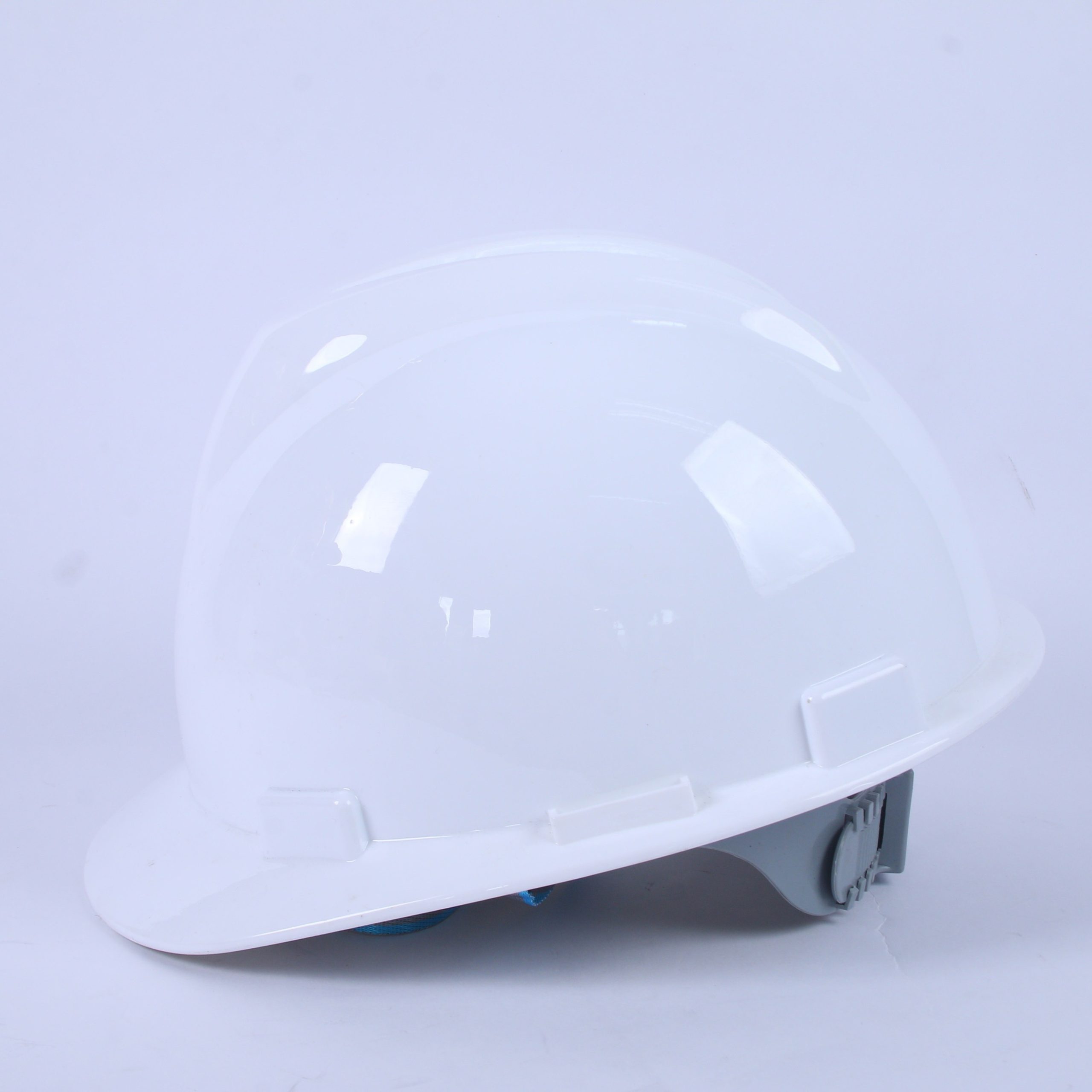
- Combine gloves with helmets, footwear, eye protection and welding gloves on one PO for a single inspection and freight quote.
Why the Cut Level Decision Matters
Cut level is the single specification that decides whether a glove protects the hand or just adds cost. EN 388:2016 classifies cut resistance on a 0 to 9 scale; ANSI-ISEA 105-2016 uses A1 to A9. Buyers who write 'cut resistant gloves' on a PO without a level get whatever the supplier stocks, and the result is either an over-specified glove at 2 to 3 times the unit price, or an under-specified one that fails the actual task. This article gives you the decision logic, the comparison table, and the exact wording to put on the order so the wrong level never ships.
Two things to keep in mind before choosing. First, EN 388 and ANSI-ISEA 105 are not interchangeable: EN 388 uses the ISO 13997:2017 blade method (a 200 g blade, 100 mm stroke), while ANSI-ISEA 105 uses a modified TDM method. A glove rated A4 under ANSI is not automatically A4 under EN 388. Second, higher cut level almost always means lower dexterity and higher unit cost, so the goal is the lowest level that covers the real hazard, not the highest available.
The Three Levels Compared

| Attribute | A4 (light) | A5 (medium) | A6 (heavy) |
|---|---|---|---|
| EN 388:2016 equivalent | Level 4 (approx) | Level 5 (approx) | Level 6 (approx) |
| ANSI-ISEA 105 A-level | A4 | A5 | A6 |
| Typical material | HPPE / Dyneema blend | HPPE / Kevlar blend | Kevlar / aramid with metal mesh option |
| Dexterity (EN 388 scale) | 4 to 5 (good) | 3 to 4 (fair) | 2 to 3 (limited) |
| Typical unit price index | 1.0x baseline | 1.4 to 1.8x | 2.2 to 3.0x |
| Typical lifespan per shift | 8 to 12 hours | 6 to 10 hours | 4 to 8 hours |
| Common task fit | Sheet metal handling, packaging | Glass, auto parts, machining | Steel fabrication, knife work, heavy sheet |
Match Level to the Actual Hazard
The right level is driven by three inputs: the sharpness and geometry of the object being handled, the force the worker applies, and the frequency of contact. A worker picking up corrugated cardboard with a clean edge needs A4. A worker handling tempered glass panels or auto stampings needs A5. A worker doing knife trimming on heavy steel sheet or working with serrated blades needs A6, and in some cases a metal mesh glove over a liner.
- A4 is the default for logistics, packaging, and general workshop handling where edges are clean and forces are low.
- A5 is the default for automotive, glass, and light machining where edges are sharp and handling is repetitive.
- A6 is required for steel fabrication, knife trimming, and any task where the worker grips a sharp edge under load.
- If the task involves both cutting and welding, specify a separate welding glove (EN 12477 Type A) and do not mix the two on one line item.
- If the task involves chemicals as well as cuts, specify EN 374 chemical resistant gloves; cut level and chemical level are separate test axes.
Write the Requirement Correctly on the PO
A PO line that says 'cut resistant gloves, A5' is not enough. The following fields must be on the order, otherwise the supplier has to guess and the buyer has to re-buy. Each field below is a real source of returned goods in our shipments.
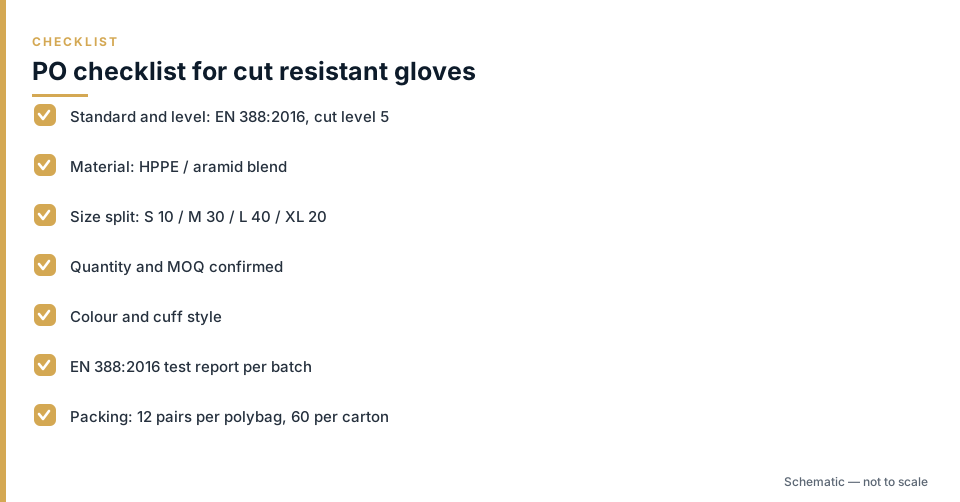
| Field | Example value | Why it matters |
|---|---|---|
| Standard and level | EN 388:2016, cut level 5 | Prevents EN/ANSI mix-up |
| Material | HPPE / aramid blend | Controls dexterity and feel |
| Sizes | S, M, L, XL in 10/30/40/20 split | Avoids size rework |
| Quantity | 500 pairs (MOQ 200) | Locks in unit price |
| Colour | Grey with black cuff | Site visibility and house rule |
| Test report | EN 388:2016 test report per batch | Verifiable on arrival |
| Packing | 12 pairs per polybag, 60 per carton | Matches your warehouse SKU |
The cheapest cut resistant glove is the one that matches the actual hazard. Buying A6 for an A4 task is not a safety upgrade; it is a cost error that also makes workers take the gloves off.
Verify the Certificate Before You Pay
Every EN 388 glove should ship with a test report showing the six-digit code and the cut level measured on ISO 13997:2017. Check three things on the report: the standard number and year (EN 388:2016, not the older 2003 version), the cut level digit, and the batch or lot number that matches the goods. If the supplier quotes an ANSI-ISEA 105 A-level instead, ask for the TDM test data and do not assume it maps 1:1 to EN 388.
- Ask for the EN 388:2016 test report before shipping, not after.
- Confirm the cut level digit, not just the marketing label 'cut resistant'.
- Confirm the material composition, because HPPE-only gloves behave differently from HPPE/aramid blends.
- Confirm the size chart is measured in palm circumference in millimetres, not just S/M/L letters.
- Ask for the packing list to match carton count against your receiving plan.
Combine with the Rest of the Site Kit
Cut resistant gloves rarely travel alone. On a fabrication site, the same PO usually carries safety helmets (EN 397), safety footwear (EN ISO 20345 S1P or S3), eye protection (EN 166), and welding gloves (EN 12477 Type A) for the welding bay. On a chemical handling site, add EN 374 chemical resistant gloves and EN 149 FFP2 or FFP3 masks. Putting all of these on one PO means one inspection, one container, one set of documents, and one freight quote. If you also need pipe fittings, flanges, fasteners or wire mesh for the same project, they can ride the same shipment as a secondary line.
Frequently Asked Questions
What is the difference between A4, A5 and A6 cut resistant gloves?
A4 is the light duty level for packaging and general handling. A5 is the medium level for glass, auto parts and light machining. A6 is the heavy level for steel fabrication and knife work. Higher level means more cut resistance but lower dexterity and higher unit cost.
Are EN 388 levels the same as ANSI-ISEA 105 A-levels?
No. EN 388:2016 uses the ISO 13997:2017 blade method, while ANSI-ISEA 105-2016 uses a modified TDM method. A glove rated A4 under ANSI is not automatically A4 under EN 388. Specify the standard you need on the PO and request the matching test report.
Can AiQi Nova manufacture to our drawing?
Yes. Non-standard parts are made to drawing, with inspection and documents on request. For cut resistant gloves this covers custom cuff length, custom colour, custom logo placement and custom size splits.
What is the minimum order quantity for cut resistant gloves?
MOQ is typically 200 pairs per style and size split. Larger orders reduce unit price and allow consolidated packing. Ask for the current MOQ and lead time on the specific style you need.
Do you supply welding gloves together with cut resistant gloves?
Yes. Welding gloves (EN 12477 Type A) are supplied on the same PO as cut resistant gloves, along with helmets, safety footwear, eye protection and other PPE. One inspection, one container, one set of documents.