Chemical Resistant Gloves Selection: EN 374 vs ANSI/ISEA 105

Key Takeaways
- EN 374 and ANSI/ISEA 105 measure chemical permeation, not abrasion.
- Always match the glove material to your specific chemical list.
- Specify the standard, type/level, material, length, and thickness on your PO.
- Request the permeation test report for the exact chemical you handle.
- Certificates are matched to your order; custom tests can be arranged on request.
Choosing the wrong chemical glove can mean permeation, skin burns, or even systemic toxicity. The most common mistake is treating an abrasion rating (EN 388) as if it were a chemical permeation rating (EN 374). This guide separates the two standards, explains what each level means in practice, and gives you a decision path for selecting nitrile, PVC, or neoprene gloves for your specific chemical list.
EN 374 vs ANSI/ISEA 105: What Each Standard Measures
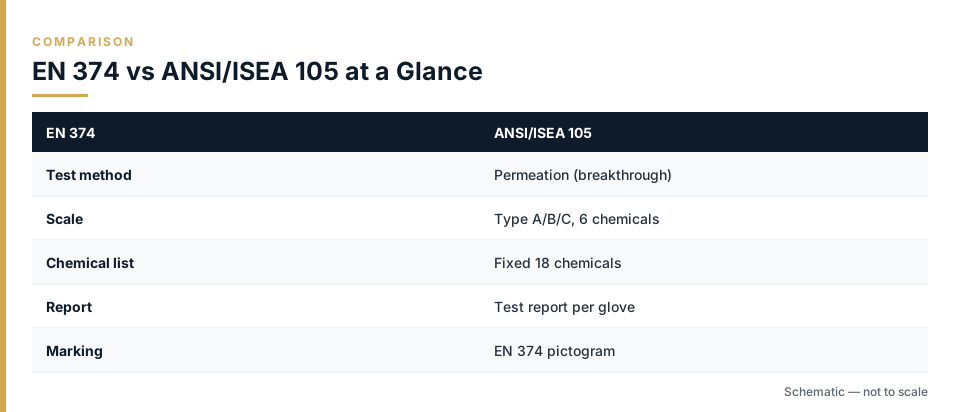
EN 374 is the European standard for protective gloves against chemicals and microorganisms. It tests permeation (breakthrough time) and degradation. ANSI/ISEA 105 is the North American standard that covers chemical resistance as one of several performance attributes, but it uses a different scale and does not require a full permeation test for every chemical. You must match the standard to your market and your chemical exposure.
| Attribute | EN 374 | ANSI/ISEA 105 |
|---|---|---|
| Test method | Permeation (breakthrough) | Permeation, degradation, or both Scale |
| Type A/B/C, 6 chemicals | Level 0-6 per chemical Chemical list |
Fixed 18 chemicals |
| Any chemical, buyer-specified Report |
Test report per glove | Test report per glove Marking |
| EN 374 pictogram | ANSI/ISEA 105 label |
EN 374 Type A means the glove has breakthrough times of at least 30 minutes against at least 6 of the 18 standard test chemicals. Type B is 3 chemicals, Type C is 1 chemical. ANSI/ISEA 105 level 0-6 indicates permeation breakthrough time: Level 0 is less than 10 minutes, Level 3 is at least 30 minutes, Level 6 is at least 480 minutes. Always check the specific chemical, not just the overall level.

Material Selection: Nitrile, PVC, or Neoprene
Each glove material has a different chemical resistance profile. Nitrile handles oils, fuels, and many acids. PVC resists acids and alkalis but not solvents. Neoprene offers broad protection against acids, alcohols, and some solvents. Match the material to your chemical list, not to the price.
| Material | Good against | Poor against |
|---|---|---|
| Nitrile | Oils, fuels, acids | Ketones, some solvents PVC |
| Acids, alkalis | Solvents, oils Neoprene |
Acids, alcohols, oxidizers |
| Oils, some ketones |
For mixed chemical exposure, consider a coated glove (e.g., nitrile-coated with a cotton liner) or a multi-layer glove. Always request the permeation test report for the specific chemical you handle. If the report is not available, treat the glove as unrated and choose a higher level or a different material.
How to Specify Chemical Gloves on Your PO
Your purchase order should include: standard (EN 374 or ANSI/ISEA 105), type or level, material, length, thickness, and any additional requirements like grip or cut resistance. Specify the chemical or chemical class you need protection against. This ensures the supplier provides a glove that has been tested for that chemical, not just a general-purpose glove.
- Standard: EN 374 Type A or ANSI/ISEA 105 Level 3+
Material: nitrile, PVC, neoprene, or coated
Length: 300 mm, 400 mm, or elbow-length
Thickness: e.g., 0.38 mm or 0.50 mm
Grip: textured or smooth
Certificates: permeation test report, EN 374 test report, or ANSI/ISEA 105 report
Inspection and Documents on Request
Before shipping, inspect gloves for pinholes, tears, and uniform thickness. Request the permeation test report and the declaration of conformity. Certificates are matched to your order and confirmed per order. If you need a specific test for a chemical not on the standard list, ask for a custom test — it can be arranged on request.
The breakthrough time is the number that matters — not the glove's color or price.
Key Takeaways
- EN 374 and ANSI/ISEA 105 measure chemical permeation, not abrasion.
Always match the glove material to your specific chemical list.
Specify the standard, type/level, material, length, and thickness on your PO.
Request the permeation test report for the exact chemical you handle.
Certificates are matched to your order; custom tests can be arranged on request.
FAQ
Q: What is the difference between EN 388 and EN 374? A: EN 388 tests mechanical risks (abrasion, cut, tear, puncture). EN 374 tests chemical permeation. They are independent — a glove can be high in one and low in the other.
Q: How do I know which EN 374 type I need? A: Identify the chemicals you handle. If you need protection against at least 6 of the 18 standard chemicals, choose Type A. For fewer, Type B or C may suffice. Always verify with the test report.
Q: Can I request a test for a chemical not on the EN 374 list? A: Yes. Custom permeation tests can be arranged on request. Provide the chemical name and expected exposure time.
Q: What documents should I ask for? A: Request the EN 374 or ANSI/ISEA 105 test report, the declaration of conformity, and any custom test reports. Certificates are matched to your order and confirmed per order.
Q: How do I inspect gloves on arrival? A: Check for pinholes, tears, and uniform thickness. Verify the marking on the glove matches the standard and level you ordered. If possible, do a water leak test on a sample.
Frequently Asked Questions
What is the difference between EN 388 and EN 374?
EN 388 tests mechanical risks (abrasion, cut, tear, puncture). EN 374 tests chemical permeation. They are independent — a glove can be high in one and low in the other.
How do I know which EN 374 type I need?
Identify the chemicals you handle. If you need protection against at least 6 of the 18 standard chemicals, choose Type A. For fewer, Type B or C may suffice. Always verify with the test report.
Can I request a test for a chemical not on the EN 374 list?
Yes. Custom permeation tests can be arranged on request. Provide the chemical name and expected exposure time.
What documents should I ask for?
Request the EN 374 or ANSI/ISEA 105 test report, the declaration of conformity, and any custom test reports. Certificates are matched to your order and confirmed per order.
How do I inspect gloves on arrival?
Check for pinholes, tears, and uniform thickness. Verify the marking on the glove matches the standard and level you ordered. If possible, do a water leak test on a sample.