S1P vs S3 Safety Footwear: What the Codes Actually Buy You
Key Takeaways
- S1P covers impact, compression, closed heel and a midsole puncture plate; it does not cover wet ground or sole puncture.
- S3 adds waterproof construction and a puncture-resistant outsole, which is what most construction and demolition sites actually need.
- SRC is a slip-resistance tier tested on two surfaces; it is mandatory in S3 SRC and optional in S1P and S3.
- Write the full code, optional layers and requested test documents on the PO before you quote, not after the site complains.
- Match the grade to the walking surface and debris type, not to the lowest unit price.
Why the S1P to S3 Gap Is Not Just Price
The price difference between S1P and S3 boots is usually 30 to 60 percent on a per-pair basis. Buyers who default to the cheaper code save cash on the PO and pay it back in site complaints, injury reports and reorders. The right question is not which code is cheaper but which hazards the workers actually walk through every shift, and which of those hazards the code is tested to resist. EN ISO 20345 defines the base safety-toe requirement and then layers optional protection on top. S1P, S3 and S3 SRC are three different combinations of those layers.
What Each Code Actually Includes
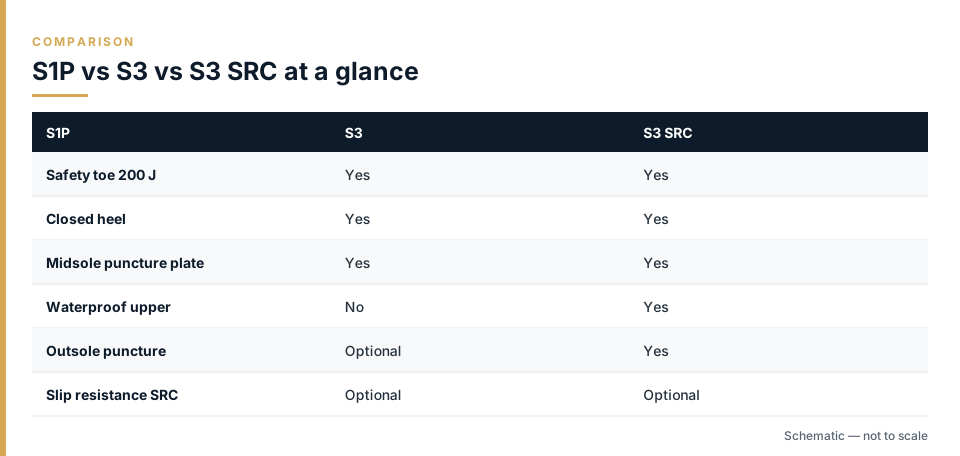
All three grades share the same base: a safety toe cap rated to 200 joules of impact and 15 kilonewtons of compression, plus a defined minimum energy absorption in the heel. Everything else is optional and is what drives the price. The table below lists the layers that distinguish the three codes.
| Layer | S1P | S3 | S3 SRC |
|---|---|---|---|
| Safety toe 200 J / 15 kN | Yes | Yes | Yes |
| Closed heel counter | Yes | Yes | Yes |
| Puncture-resistant midsole | Yes (steel plate) | Yes (steel plate) | Yes (steel plate) |
| Waterproof construction | No | Yes | Yes |
| Metatarsal protection | Optional | Optional | Optional |
| Puncture-resistant outsole | Optional | Yes | Yes |
| Slip resistance (SRC) | Optional | Optional | Yes (mandatory) |
Where S3 Earns Its Premium
S3 is the code to reach for when the site has wet ground, sharp debris or both. The waterproof upper and membrane keep the foot dry in standing water, slurry or after a washdown. The puncture-resistant outsole is tested to a steel nail pushed through at a defined force, which matters on demolition, rebar, scrap and construction sites where nails and shards sit on the walking surface. S1P covers puncture through the midsole only, so a sharp object entering through the sole is not addressed.
- Choose S3 when workers walk on wet, muddy or slurry surfaces for more than a short period per shift.
- Choose S3 when the site has exposed nails, sharp metal, glass or rebar on the walking surface.
- Choose S1P for indoor workshops, warehouses and clean industrial floors with dry surfaces and low puncture risk.
- Choose S1P for office-adjacent plant areas where the main hazard is toe impact from falling stock, not wet or sharp ground.
What SRC Adds and When It Is Worth It
SRC stands for Slip Resistance Category. It is a combined test of the outsole against a ceramic tile surface with glycerol and a steel surface with sodium dodecyl sulfate. SRC is the strictest of the SRA, SRB and SRC tiers under EN ISO 20345. It is not mandatory in S1P or S3, but it becomes mandatory in S3 SRC. For sites with polished concrete, oil-contaminated floors, food processing washdowns or wet plant areas, SRC is the layer that actually reduces slips. Without it, a boot can be S3 compliant and still slide on a wet tile floor.
How to Write the Requirement on the PO
Most site disputes come from a PO that says only safety boots. Write the code, the optional layers and the test evidence you expect. A tight specification shortens the quote cycle and removes the argument at delivery.
- State the standard and grade in full: EN ISO 20345 S3 SRC, safety toe 200 J / 15 kN.
- State the size range and sizing system (EU, UK or US) so returns do not cycle back.
- State the colour and any hi-vis strip requirement if the site uses EN ISO 20471 Class 2 or 3.
- Request the test certificate for the specific model, not a generic brand certificate.
- Request the batch inspection report and a sample pair before the full order ships.
- Confirm the MOQ, lead time and packing (pairs per carton, cartons per pallet) on the quotation.
The code on the box tells you what the boot was tested to resist, not what the site will throw at it. Match the code to the hazard, not to the budget.
Cost Per Pair vs Cost Per Incident
A single foot injury on a construction site typically costs more than a full season of S3 boots for a crew of twenty, once you include downtime, medical, reporting and the site audit that follows. The comparison below is a rough planning figure, not a quote. Use it to size the conversation with your site manager, not to price a PO.
| Item | S1P | S3 SRC |
|---|---|---|
| Footwear cost per pair | Baseline | Plus 30 to 60 percent |
| Expected replacement cycle | 12 to 18 months | 12 to 18 months |
| Coverage of wet ground | No | Yes |
| Coverage of sharp debris on sole | No | Yes |
| Slip resistance tier | Optional | SRC mandatory |
Frequently Asked Questions
What is the difference between S1P and S3 safety footwear?
Both are EN ISO 20345 grades with a 200 joule safety toe and a steel midsole puncture plate. S3 adds waterproof construction and a puncture-resistant outsole, so it covers wet ground and sharp debris entering through the sole. S1P does not.
Is S3 SRC better than S3?
S3 SRC is S3 with the SRC slip-resistance test made mandatory. On dry or lightly wet floors the two perform similarly. On polished concrete, oil-contaminated floors or washdown areas, SRC measurably reduces slip distance.
Can S1P be used on a construction site?
S1P is acceptable for indoor workshops, warehouses and clean plant areas. For outdoor construction with mud, standing water or sharp debris on the walking surface, S3 or S3 SRC is the appropriate grade.
Do we need a test certificate for every pair?
No. EN ISO 20345 is a type-test standard, so the certificate is issued against a specific model. Request the test certificate for the exact model and size range you are ordering, plus a batch inspection report for the shipment.
Can AiQi Nova manufacture to our drawing?
Yes. Non-standard parts are made to drawing, with inspection and documents on request. For safety footwear we supply to EN ISO 20345 grades S1P, S3 and S3 SRC, with the matching test certificate and batch inspection report on request.