EN ISO 11612 Code Letters Explained: What Your FR Workwear Actually Protects
Key Takeaways
- EN ISO 11612 uses six code positions (A-F), each testing a different heat hazard; level 2 is higher performance than level 1.
- Match the code to your site hazard first: foundry work needs C1 or D1, furnace work needs F1, welding needs A1 B1.
- An X in any position means the garment was not tested for that hazard; do not assume protection.
- Always request the test certificate before signing; verify the standard reference, code string, and accredited lab.
- Specify fabric weight, closure type, size range, and packing on the PO alongside the code letters.
Why the Code Letters Matter on Your PO
EN ISO 11612 is the European standard for protective clothing against short contact with flame and heat. Every compliant garment carries a six-position code such as A1 B2 C1 D1 E1 F1. Each position is a separate test. A garment that passes A1 only has been tested against a specific flame source; it has not been tested against molten metal splash. If your site involves foundry work, welding, or hot oil handling and you buy a garment coded only for A1, you are paying for protection you do not have. Reading the code before you order is the difference between a compliant garment and a liability.
The Six Positions, Decoded
Each letter stands for a specific heat hazard. The number after the letter is the performance level, always 1 or 2. Level 2 is the higher performance. A position marked X means the garment was not tested for that hazard and must not be assumed to protect against it.
| Position | Hazard tested | Level 1 | Level 2 | Typical site exposure |
|---|---|---|---|---|
| A | Flame spread | Limited flame spread | Limited flame spread | Welding sparks, open flame |
| Welding, hot work | B | Contact with flame | Limited flame spread | Limited flame spread |
| Brief contact with flame | Foundry, hot work | C | Contact with molten metal | Limited metal splash |
| Limited metal splash | Aluminium, zinc, steel splash | Foundry, metal pouring | D | Contact with molten aluminium |
| Limited aluminium splash | Limited aluminium splash | Aluminium pouring | Aluminium foundry | E |
| Contact with molten iron | Limited iron splash | Limited iron splash | Iron pouring | Steel foundry |
| F | Thermal radiation | Limited heat transfer | Limited heat transfer | Radiant heat from furnace |
| Furnace, kiln, boiler |
Matching the Code to Your Site Hazard
Start from the hazard, not from the garment. Identify the dominant heat source on the job, then require the matching position at the correct level. A single code letter is rarely enough for a real site; most industrial environments expose workers to more than one heat source.
| Site scenario | Minimum code positions | Notes |
|---|---|---|
| Welding and hot work | A1 B1 | Add C1 if sparks reach molten metal |
| Steel foundry, iron pouring | A1 B1 C1 E1 | E1 for radiant heat from furnace |
| Aluminium foundry | A1 B1 C1 D1 | D1 is specific to molten aluminium |
| Boiler and furnace maintenance | A1 B1 F1 | F1 for radiant heat exposure |
| General hot work, mixed tasks | A1 B1 C1 | Baseline for most industrial sites |
What to Verify on the Certificate
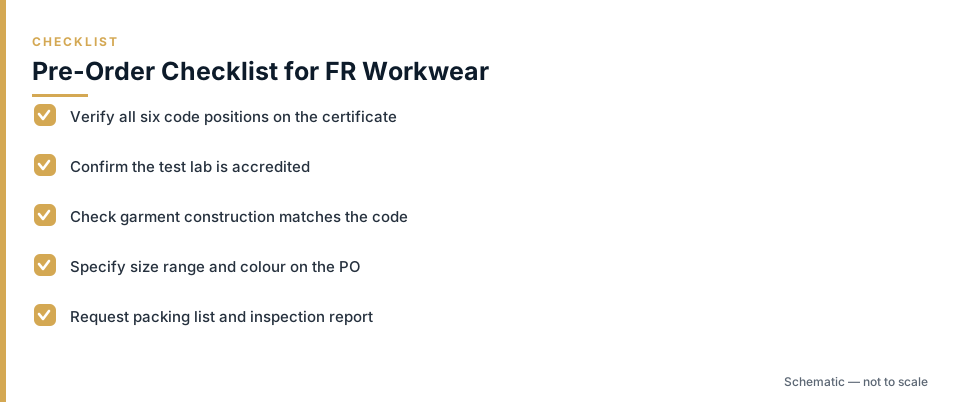
The certificate is the only document that proves the code letters. Ask for the test report or certificate of conformity before you sign. Check the following fields; a missing or vague field is a reason to pause the order.
- Standard reference: must read EN ISO 11612:2015 (or the current edition).
- Code string: all six positions listed, with X where not tested.
- Test laboratory: an accredited body, not the manufacturer alone.
- Garment construction: size range, closure type, and whether the code applies to the full garment or only the fabric.
- Date of issue and validity period.
- Manufacturer name and address, matching the supplier on the PO.
Buying Factors Beyond the Code
The code letters confirm heat protection, but they do not cover fit, durability, or comfort. Specify these alongside the code so the garment is actually usable on site.
- Fabric weight: 220-300 g/m2 is typical for industrial FR workwear; heavier for foundry.
- Closure type: front zip with storm flap, or hook-and-loop; specify per site access needs.
- Size range: request the full size chart before ordering; EU sizing differs from US sizing.
- Colour: navy, grey, or black are standard; hi-vis FR variants exist under EN ISO 20471.
- Inspection: request a pre-shipment inspection report and a copy of the test certificate with each shipment.
- Packing: individual polybag per garment with size label, or bulk carton; specify on the PO.
A code letter you did not ask for is a hazard you did not protect against.
Frequently Asked Questions
Can AiQi Nova manufacture to our drawing?
Yes. Non-standard parts are made to drawing, with inspection and documents on request. For FR workwear, we supply to EN ISO 11612 code specifications and provide the test certificate with each shipment.
What is the difference between level 1 and level 2?
Level 2 is the higher performance level. For example, A2 means the fabric showed less flame spread than A1. Level 2 is required for more severe exposures such as prolonged radiant heat or heavy molten metal splash.
Can I buy FR workwear and hi-vis workwear in the same order?
Yes. FR workwear under EN ISO 11612 and hi-vis workwear under EN ISO 20471 can be combined on one PO. Some garments carry both codes; specify which standard and class you need for each item.
Do the code letters cover chemical or electrical hazards?
No. EN ISO 11612 covers heat and flame only. For chemical resistance, specify EN ISO 6529 or EN 13034. For electrical arc flash, specify EN 1149 or the relevant arc flash standard.
What documents should I request with each shipment?
Request the test certificate or certificate of conformity for EN ISO 11612, a pre-shipment inspection report, and the packing list. All documents are provided on request with each order.