EN 397 vs ANSI Z89.1 Safety Helmet: What Changes for Importers
Key Takeaways
- EN 397 and ANSI/ISEA Z89.1 are not interchangeable; the shell is the same, the certificate is not.
- Write the standard, electrical rating, and suspension type on the PO, not just the colour and quantity.
- Request the test certificate and declaration of conformity before the vessel sails, not after arrival.
- A shell marked to one standard but certified to the other is the most common reason for customs rejection.
- Two standards can ship in one container if each line has its own certificate and its own carton label.
Why This Decision Matters at the Container Gate
A helmet that clears inspection in Rotterdam can be rejected at a US port, and vice versa. EN 397 and ANSI/ISEA Z89.1 are not interchangeable: they differ in impact energy, drop height, electrical test voltage, suspension requirements, and the marking that must appear on the shell. If your purchase order does not state which standard the helmet is tested to, the certificate you receive will not match the market you are shipping into, and the whole container can be held or returned. This guide gives you the fields to write on the PO, the tests to ask for, and the documents to request before the vessel sails.
Test Requirements Side by Side
Both standards drop a steel striker onto the shell and measure force transmitted to the suspension. The numbers differ, and so does the electrical test. A helmet marked to one standard is not automatically compliant with the other, even if the shell looks identical.
| Parameter | EN 397 | ANSI/ISEA Z89.1 Type I |
|---|---|---|
| Striker mass | 5 kg | 5.44 kg |
| Drop height | 1 m | 1.07 m |
| Max force to suspension | 5 kN | 4.4 kN |
| Electrical test voltage | 4,400 V AC (optional) | 2,200 V AC (optional) |
| Penetration test | Yes, 5 kg / 1 m | Yes, 5.44 kg / 1.07 m |
| Suspension required | Yes, integral or separate | Yes, integral or separate |
| Marking on shell | EN 397 + manufacturer + date | ANSI Z89.1 + manufacturer + date |
What to Write on the Purchase Order
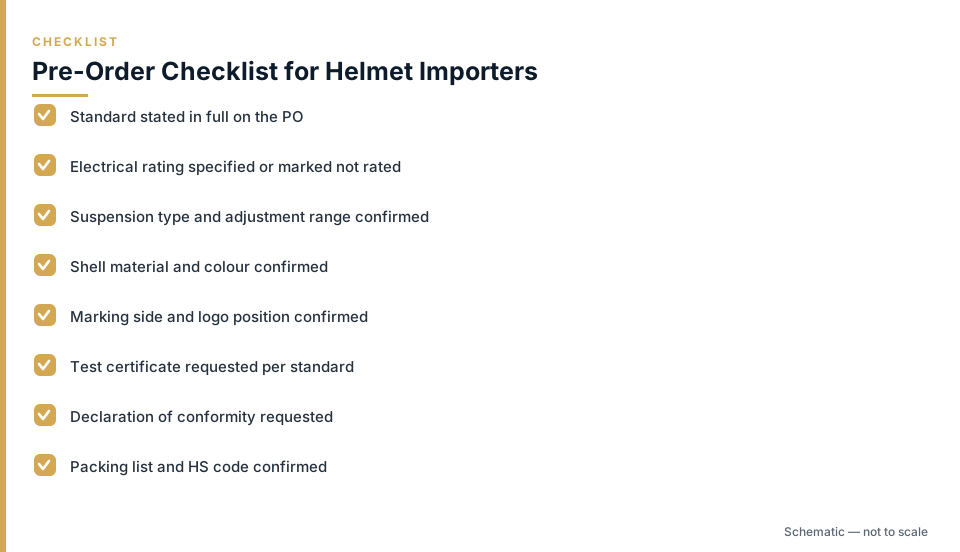
A generic line such as 'safety helmet, white, 500 pcs' is not enough. Customs brokers and receiving inspectors in the EU and US ask for the standard number, the electrical rating, and the test certificate reference. Write these fields explicitly.
- Standard: EN 397:2012 or ANSI/ISEA Z89.1-2014, stated in full
- Type: Type I (single impact) or Type II (multi-impact) where applicable
- Electrical rating: non-conductive to 4,400 V AC (EN) or 2,200 V AC (ANSI), or 'not rated'
- Suspension: integral or separate, with adjustment range
- Shell material: HDPE, ABS, fiberglass, or Kevlar composite
- Colour and marking: shell colour, logo position, marking side
- Quantity per colour, packing per carton, and container loading plan
- Documents required: test certificate, declaration of conformity, packing list, commercial invoice
Documents to Request Before Shipment
The certificate is what the importer's compliance team and the destination customs officer actually read. Ask for the following before the vessel departs, not after arrival.
- Test certificate from an accredited laboratory, naming the standard and the model
- Declaration of conformity signed by the supplier, referencing the certificate number
- Batch or lot number matching the shell marking
- Material declaration for the shell and suspension
- Packing list with carton count, gross weight, and dimensions per carton
- Commercial invoice with HS code 6506.10 or 6506.91 as applicable
The shell is the same part. The certificate is what decides whether the container clears.
Common Rejection Points at Inspection
Most customs holds on safety helmets come from three sources: a missing or mismatched certificate, a shell marked to the wrong standard, or an electrical rating that was not tested. Check these before you ship.
- Shell marked EN 397 but certificate references ANSI Z89.1, or the reverse
- Electrical rating claimed on the PO but no electrical test report attached
- Suspension not included, or included but not listed on the certificate
- Batch number on the shell does not match the certificate lot
- Certificate older than the model revision date, or issued for a different shell geometry
Ordering Both Standards in One Container
If you serve both European and North American customers, you can consolidate two helmet lines into one container. Keep them in separate cartons with separate packing lists, and request a separate certificate per standard. The supplier can match certificates to each line on the same order, with inspection and documents provided before shipment.
- Split the order into two line items, one per standard
- Request a separate test certificate for each line item
- Label cartons with the standard and the destination market
- Confirm the HS code and marking side with the receiving inspector before loading
- Ask for a combined packing list that references both certificates
Frequently Asked Questions
Can I use the same helmet model for both EN 397 and ANSI Z89.1 markets?
Yes, if the supplier tests the same shell to both standards and issues a separate certificate for each. The shell marking must match the standard for the destination market, so ask for two marked variants or confirm the marking side with your receiving inspector.
What electrical rating should I specify for a construction site?
For general construction, a non-conductive shell rated to 4,400 V AC (EN 397) or 2,200 V AC (ANSI Z89.1) is typical. For live electrical work, specify the higher rating and confirm the test report covers that voltage.
How long is a test certificate valid?
There is no fixed expiry in either standard. The certificate is valid as long as the shell geometry, material, and suspension remain unchanged. If the supplier revises the model, request a new certificate before ordering.
Can AiQi Nova manufacture to our drawing?
Yes. Non-standard parts are made to drawing, with inspection and documents on request. For helmets, this includes custom shell colour, logo placement, and marking side, with the test certificate matched to the standard you specify.
What is the minimum order quantity for a single standard?
MOQ depends on shell colour and marking. Ask for the current MOQ per colour and per standard on the quotation. Consolidating two standards into one container usually lowers the per-unit freight cost.