FFP2 vs FFP3 vs Half Mask: Match Respiratory Protection to the Hazard

Key Takeaways
- FFP2 covers particulate under ten times the OEL; FFP3 covers silica and fine metal dust above that band.
- Any vapour hazard requires an EN 140 half mask with the correct EN 14387 filter series, not an FFP filter.
- Specify standard, class, filter series, quantity and certificate number on every PO line.
- Request the certificate of conformity, test report and packing list before loading the container.
- Bundle respiratory protection with gloves, helmets, footwear and eye protection on one PO to cut landed cost.
Why This Choice Costs You Money
A respirator that is too weak fails the worker; one that is too heavy gets pulled off within ten minutes. Both outcomes end up in the same place: a safety incident report and a re-order. The decision is not which filter is stronger. It is which filter matches the hazard you actually have on site, and which one the worker will keep on for a full shift.
Three hazards dominate most construction, fabrication and chemical-handling sites in the Middle East, Southeast Asia and Central Asia: respirable dust, organic vapour, and welding fume. Each one needs a different answer, and buying one FFP2 box to cover all three is the single most common specification error we see on incoming purchase orders.
The Three Options at a Glance
| Attribute | FFP2 (EN 149) | FFP3 (EN 149) | Half Mask (EN 140 + EN 14387 filter) |
|---|---|---|---|
| Hazard type | Particulate only | Particulate only | Particulate or vapour, by filter choice |
| Filtering efficiency | At least 94 percent at 0.6 micrometre | At least 99 percent at 0.6 micrometre | Depends on selected filter class |
| Vapour protection | No | No | Yes, with ABEK or A2 filter cartridge |
| Weight on face | Light, 40 to 60 grams | Slightly heavier, 50 to 70 grams | 300 to 500 grams with straps |
| Heat tolerance | Comfortable in 30 to 40 C ambient | Tolerable up to 45 C | Poor in sustained heat, sweating under strap |
| Typical use | Concrete dust, sanding, demolition | Silica, asbestos-adjacent, fine metal dust | Paint spray, solvent, welding with vapour |
| Regulatory reference | EN 149:2019+A1:2009 | EN 149:2019+A1:2009 | EN 140:1998 + EN 14387 filter series |
Match the Filter to the Hazard
Start from the hazard, not from the product catalogue. Identify what the worker inhales, estimate the concentration band, and only then pick the class. The table below is the practical shortcut most site supervisors end up using.

| Hazard on site | Typical concentration band | Correct class | What to specify on the PO |
|---|---|---|---|
| Concrete or stone dust | Under 10 times the OEL | FFP2 | EN 149 FFP2 R, particulate only |
| Silica or fine metal dust | 10 to 50 times the OEL | FFP3 | EN 149 FFP3 R or Rr |
| Welding fume, MIG or arc | Variable, high particulate | FFP3 | EN 149 FFP3 R, heat-tolerant outer layer |
| Paint or solvent spray | Organic vapour present | Half mask | EN 140 mask + EN 14387 A2 filter |
| Mixed dust plus vapour | Both particulate and vapour | Half mask | EN 140 + EN 14387 A2P3 combination filter |
| Silicone or mould release agents | Volatile organic compounds | Half mask | EN 140 + EN 14387 ABEK-P3 filter |
One rule covers most of these rows: if the hazard is only particulate and the concentration is under ten times the occupational exposure limit, FFP2 is sufficient. If it is silica, asbestos-adjacent material, or fine metal dust above that band, move to FFP3. If there is any vapour component at all, FFP filters do not work and a half mask with the correct filter cartridge is mandatory.
The most expensive respirator on your site is the one the worker takes off in the first ten minutes and never puts back on.
How to Write It on the Purchase Order
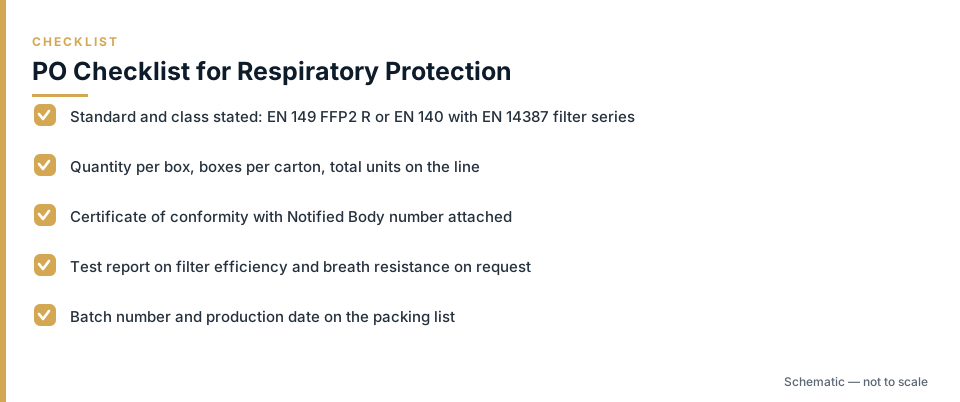
A vague line such as dust mask FFP2 boxes 1000 is the reason you receive the wrong product. Every respiratory protection line on the PO should carry four fields, and each one must be verifiable against the certificate of conformity supplied with the shipment.
- Standard and class: EN 149:2019+A1:2009 FFP2 R, or EN 140:1998 with EN 14387 A2P3 filter.
- Quantity and pack: number of masks per box, boxes per carton, total units per PO line.
- Certificate: CE type examination certificate number and Notified Body reference, attached per shipment.
- Inspection: batch test report on request, visual and fit-check sample before loading.
For half masks, add the filter series explicitly. EN 14387 covers particulate (P1, P2, P3), organic vapour (A1, A2, A3), inorganic gas (B1, B2, B3), ammonia (E1, E2, E3), cyanide (K1, K2, K3), and combinations such as ABEK-P3. Omitting the series is the second most common specification error after omitting the FFP class.
Fit, Comfort and the Real Reason Masks Get Removed
The worker removes the mask for one of three reasons: heat, strap pressure, or a poor facial seal. FFP2 and FFP3 disposable masks solve this with lighter weight and no straps. Half masks solve it only if the shell size is matched to the face shape and the filter is not oversized for the hazard.
- Face size: half masks come in S, M, L; order at least two sizes per worker cohort.
- Heat tolerance: in ambient above 35 C, disposable FFP is preferred over half mask for particulate-only hazards.
- Strap quality: elastic straps should not show crease cracking after 200 cycles.
- Filter life: A2 cartridge is rated for 12 hours in moderate vapour; replace on schedule, not on smell.
A practical compromise for hot sites is to specify FFP3 R for particulate work and reserve half masks for the subset of tasks that involve vapour. This keeps the majority of the workforce in lighter gear without dropping protection where it matters.
Documents to Request Before You Ship
Every EN 149 and EN 140 product we supply comes with a certificate of conformity that names the standard, the class, the manufacturer and the Notified Body that issued the type examination. Before you close the PO, ask for three documents and check three fields on each.
- Certificate of conformity: check standard number, class, manufacturer name, Notified Body number.
- Test report: check filter efficiency percentage, breath resistance in Pa, and temperature exposure if applicable.
- Packing list: check batch number, production date, and expiry date if a shelf life is stated.
If any of these fields is missing or does not match the PO line, flag it before loading. A respirator without a traceable certificate is a liability the importer carries, not the supplier.
Bundle It With the Rest of the Site Kit
Respiratory protection rarely travels alone. On a single site you will also need EN 388 cut-resistant gloves, EN 397 helmets, EN ISO 20345 S3 safety footwear, EN 352 ear protection and EN 166 eye protection. Consolidating these on one PO, one container and one set of shipping documents cuts landed cost and simplifies customs clearance in the UAE, Saudi Arabia, Vietnam and Malaysia.
For welding-heavy sites, add EN 379 auto-darkening welding helmets and EN 12477 Type A welding gloves on the same line. For chemical handling, add EN 374 chemical-resistant gloves with the penetration class stated. These ship alongside the respiratory protection without adding a second freight line.
Frequently Asked Questions
Can AiQi Nova manufacture to our drawing?
Yes. Non-standard parts are made to drawing, with inspection and documents on request. For respiratory protection specifically, custom branding and packaging are available on quantities above the standard MOQ.
What is the practical difference between FFP2 R and FFP2 without R?
The R marking means the mask is reusable for particulate protection across multiple shifts, provided the filter media is not damaged. Without R, the mask is rated for single-shift use. Specify R when workers keep the same mask for a full day and reuse it the next day.
Can FFP3 be used for welding fume?
Yes for the particulate component of welding fume, especially MIG and arc welding. If the process also generates organic vapour from flux or coating, switch to an EN 140 half mask with an A2P3 filter cartridge.
How do we verify the certificate on arrival?
Check four fields on the certificate of conformity: standard number (EN 149 or EN 140), class (FFP2, FFP3, or filter series), manufacturer name, and Notified Body number. Cross-reference the Notified Body number against the EU Notified Bodies database before accepting the shipment.
What is the minimum order quantity for mixed FFP2 and FFP3 orders?
Standard MOQ is one carton per class, with mixed cartons available on request. Combined orders that include gloves, helmets and footwear can be consolidated into a single container with a single set of shipping documents.