Safety Harness Sizes and Fit: What to Specify for Your Crew

Key Takeaways
- Specify EN 361 compliance and the exact size range (universal or S-XXL) on your purchase order.
- Require adjustment points at the shoulders, chest, and legs, plus a back D-ring height adjustment where needed.
- Run a 3-step fit check on every worker during delivery inspection; do not rely on the size label alone.
- Verify label markings, stitching, buckles, and D-rings on delivery, and request a certificate of conformity and test report.
An ill-fitting full-body harness is a compliance and safety failure that is easy to miss. A harness that is too loose can shift during a fall, causing injury or allowing the worker to slip out; one that is too tight restricts movement and is often worn incorrectly. For a buyer, specifying the right size range and adjustment points on the purchase order is as important as choosing the correct EN 361 standard. This guide tells you exactly what to write on your PO and how to verify fit on delivery.
Size Ranges and the EN 361 Baseline
Full-body harnesses are typically offered in universal (one-size) or multi-size (S-XXL) versions. Universal harnesses rely on extensive adjustment points and are common for general use. Multi-size harnesses provide a better fit for a crew with a wide range of body types. The baseline standard is EN 361, which covers the design and performance of full-body harnesses. When you specify, confirm the harness is built to EN 361 and note the size range on the PO.
| Size Range | Chest (cm) | Waist (cm) | Thigh (cm) |
|---|---|---|---|
| S-M | 81-96 | 71-86 | 51-61 L-XL |
| 96-111 | 86-101 | 61-71 XXL |
111-126 |
| 101-116 | 71-81 Universal |
Adjustable | Adjustable |
| Adjustable |
For a crew with a wide range of body types, specify a multi-size harness and request a size chart from the supplier. For a crew with a narrow range, a universal harness with clear adjustment points is acceptable. The key is that every worker can achieve a snug fit without the harness riding up or the leg loops being too tight.

Adjustment Points to Specify on Your PO
A harness only protects if it is adjusted correctly. Specify that the harness must have adjustment points at the shoulders, chest, and legs. These three points allow the harness to be fitted to the individual worker. Some harnesses also offer a back D-ring height adjustment, which is useful for workers who need the attachment point positioned correctly for their height.
- Shoulder straps: must be adjustable to prevent the harness from riding up
Chest strap: must be adjustable to keep the shoulder straps in place
Leg straps: must be adjustable for a snug fit without cutting into the thigh
Back D-ring: must be positioned between the shoulder blades, not too high or too low
A harness that fits well is one you forget you are wearing; a harness that fits poorly is one you constantly adjust.
The 3-Step Fit Check for Every Worker
Fit must be verified on each worker, not assumed from the size label. A simple three-step check takes less than two minutes and should be part of your delivery inspection. This is a practical way to confirm the harness size range you specified actually works for your crew.
Documents and Inspection on Delivery
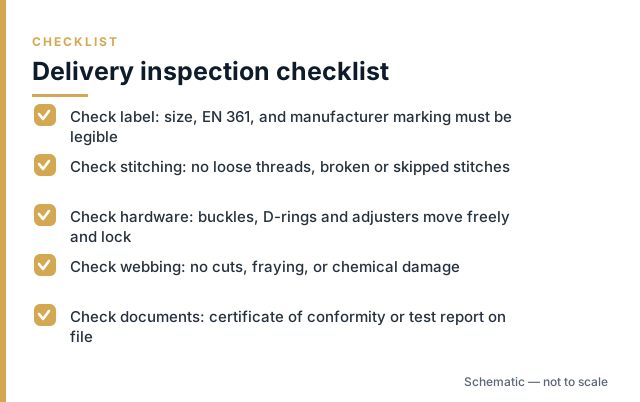
When you receive the harnesses, check that the size range on the label matches your PO. Verify each harness has a legible marking with the EN 361 standard and the size. Request a certificate of conformity or a test report from the supplier; certificates matched to your order are the norm. Keep these documents on file for your own compliance audits.
- Check label: size, EN 361, and manufacturer marking must be legible
Check stitching: no loose threads, broken stitches, or frayed webbing
Check buckles and adjusters: they must move freely and lock securely
Check D-rings: no deformation, cracks, or corrosion
Request documents: certificate of conformity and test report, on request
Practical Buying Factors
Beyond size and fit, consider the material and the quantity. Most harnesses use polyester webbing, which resists UV and chemicals better than nylon. Specify the webbing material if your crew works in harsh environments. For quantity, plan for one harness per worker plus a small buffer for replacements. A typical replacement cycle is 1 to 3 years, depending on use and inspection findings.
| Specification | What to Write on PO |
|---|---|
| Standard | Built to EN 361 Size Range |
| S-XXL (or specify S-M, L-XL) Material |
Polyester webbing Adjustment |
| Shoulder, chest, and leg straps Quantity |
One per worker + 10% buffer Documents |
| Certificate of conformity, test report on request |
Frequently Asked Questions
What standard must the harness meet?
The harness must be built to EN 361, which covers the design and performance of full-body harnesses.
Should I choose a universal or multi-size harness for my crew?
Choose a multi-size harness (S-XXL) if your crew has a wide range of body types; a universal harness is acceptable for a narrow range, provided it has clear adjustment points.
What adjustment points should I specify on the purchase order?
Specify adjustable shoulder straps, chest strap, and leg straps, and consider a back D-ring height adjustment for proper attachment point positioning.
How do I verify fit on delivery?
Perform a three-step fit check on each worker, and inspect the label, stitching, buckles, and D-rings; also request a certificate of conformity and test report.